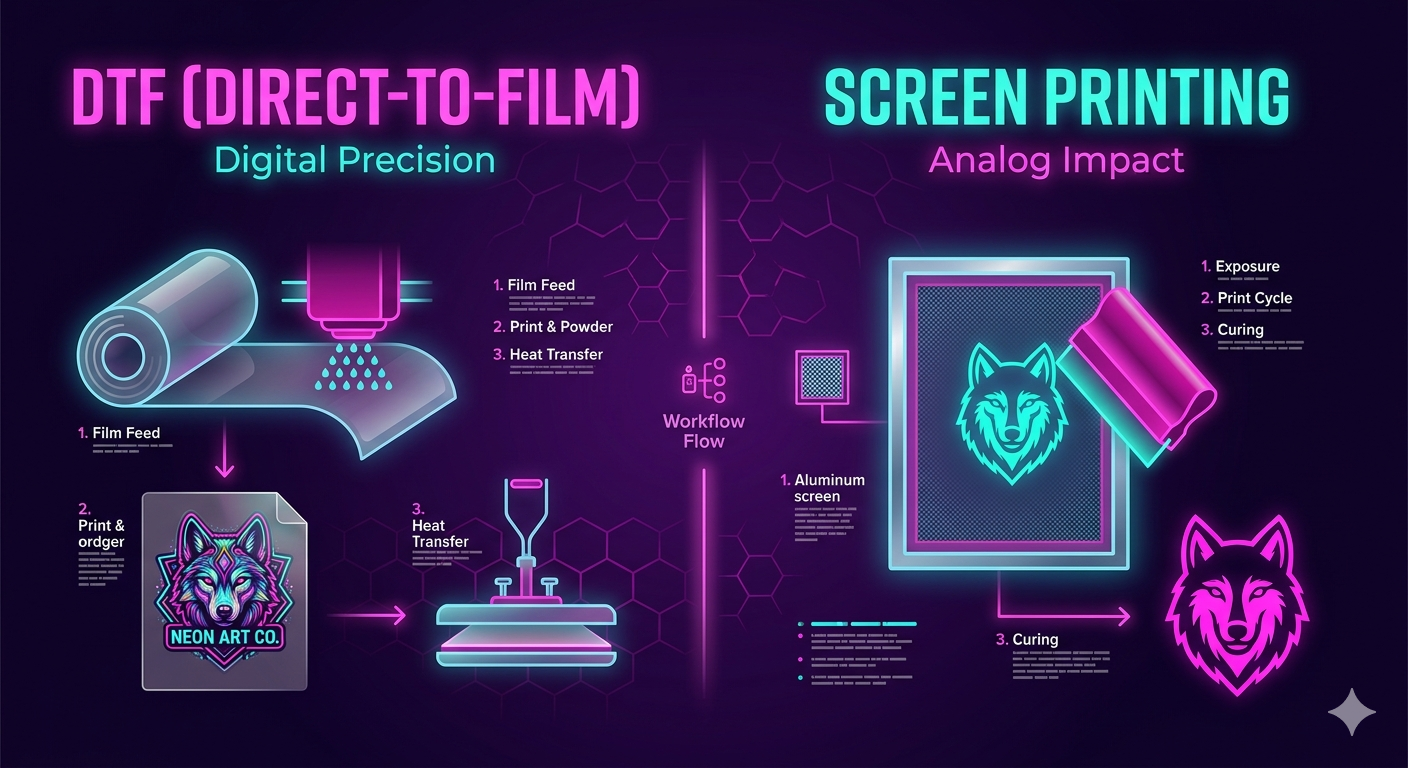
Direct-to-Film (DTF) is everywhere right now, and for good reason. It's a game-changer for some jobs, no doubt.
But here's the thing : DTF isn't a magic bullet for every single order that walks through your door. Anyone telling you otherwise hasn't run enough jobs to see the real numbers.
The smart money isn't just jumping on the new tech. It's figuring out the exact point where DTF makes you more cash than traditional screen printing. That's your crossover point, and knowing it is how you stop guessing and start printing profit.
Screen Prep vs. DTF Costs: Where Does Your Money Go?
Let's break down the grunt work. Every method has its hidden costs, and ignoring them is a one-way ticket to eating ramen for lunch.
The Screen Printing Grind
With screen printing, you're looking at upfront labor and materials for setup:
- Film Positives: Time and materials to print those perfect films.
- Screen Burning: Labor, emulsion, darkroom time. It all adds up.
- Screen Reclaiming: Washing out, stripping emulsion. More labor.
- Press Setup: Getting those screens registered, ink pulled, test prints.
These are fixed costs for the job, regardless of whether you print 10 shirts or 1000. Once the screens are on press, the per-piece cost drops significantly.
The DTF Play
DTF feels simpler, right? Just print the film, powder, cure, and press. But don't fool yourself; there are still real costs per piece:
- DTF Film: It's not free, and larger designs use more.
- DTF Ink: Pricier than your standard plastisol, especially for multi-color.
- Adhesive Powder: Another consumable that adds up with every transfer.
- Heat Press Time: You're pressing each shirt individually, which takes time and labor.
The beauty of DTF is that the setup is minimal. But those per-piece costs don't really go down much, no matter how many you print. This is crucial for finding that crossover.
The Quantity & Color Count Conundrum: Find Your Sweet Spot
This is where the rubber meets the road. The number of colors and the quantity of garments are your biggest indicators.
When DTF Shines Brightest
Think small runs, high color counts, and complex graphics.
- Low Quantity (1-24 pieces): Setup time kills profit in screen printing on small runs. DTF's minimal setup makes it a winner.
- High Color Count (5+ colors): Each screen is another setup cost in screen printing. DTF handles unlimited colors in one print job, saving you massive setup time.
- Complex Graphics & Gradients: DTF excels at photographic quality and intricate details without the fuss of halftones and screen mesh.
Consider a dozen shirts with a 6-color logo. Burning six screens, registering them, and cleaning up afterward will eat your profit alive. DTF is your buddy here.
When Screen Printing Still Reigns Supreme
For volume and simplicity, screen printing is often untouchable for sheer speed and cost-efficiency.
- High Quantity (50+ pieces): Once your screens are set, you're flying through shirts. The per-piece cost becomes incredibly low.
- Low Color Count (1-3 colors): A simple one-color job on a manual or automatic press is lightning fast and cheap per piece.
- Specific Effects: Puff, high-density, metallics – screen printing offers textural and special effect inks that DTF can't replicate.
Imagine 100 shirts with a simple one-color logo. You'll burn one screen, set it up in minutes, and be done before a DTF printer even warms up. That's pure screen printing profit.
Fabric Compatibility: Don't Get Burned
Different fabrics react differently. Knowing this saves you headaches and misprints.
- DTF's Poly Power: DTF truly excels on tricky fabrics like polyester, poly blends, and even nylon. It adheres beautifully, and the low cure temps prevent scorching or dye migration.
- Fleece Friend: DTF is also fantastic on fleece, offering good stretch and washability without the heavy hand of some screen prints.
- Screen Printing's Cotton Kingdom: For 100% cotton, especially darker garments with a solid underbase, screen printing still delivers that classic, durable feel and vibrant color that many customers prefer.
Always test, but these are good general rules of thumb.
Stop Guessing, Start Printing Profit
The bottom line is this: there's no single "best" method. There's only the most profitable method for that specific job.
You need to know your true shop hourly rate for both screen printing and DTF. Factor in every cost – labor, materials, machine wear, utilities.
When you can plug in the job details and see which method spits out a higher profit margin, that's when you're truly owning your business. Stop letting the latest trend dictate your production. Use your head, crunch the numbers, and decide like a boss.